

- Implants do not decay. Instead, the jawbone holding them can melt away. This peri-implantitis is the most common reason implants are lost.
- There is almost no pain, even after a lot of bone is gone. We call it a silent killer.
- At first, just the gum is red. Caught at this stage, it can recover. Once bone loss begins, it is hard to reverse.
- Implant surfaces should not be scraped with standard scaling tools. A scratch becomes a new place for bacteria to stick.
"Can an implant decay?" We hear this often at Reset Dental Clinic in Seomyeon, Busan. The answer is no, but peri-implantitis is what really costs people their implants. For patients living in or visiting Korea, we provide 1:1 English interpretation from your first consultation through the end of treatment.
People who lose an implant do not lose it to decay. They lose it because the area around it breaks down.
Today's topic is a heavy one. Some patients really are told, a few years later, that an implant they worked hard for must come out.
Can an implant decay, and what is peri-implantitis?
Implants do not decay. Titanium and ceramic are not materials that get cavities, but they are not safe from peri-implantitis.
So some people think an artificial tooth needs no more care. The opposite is true.
Instead of decay, inflammation forms around the implant. This is called peri-implantitis. The inflammation does not stop at the gum; it moves down and melts the jawbone.
The bone is what holds an implant in place. When that bone is gone, even an intact implant loosens and falls out.
We often say that keeping an implant is ten times harder than placing it. Surgery is half of the process, and care is the other half.
The problem should be seen in two stages. This split matters a great deal, because the first stage can reverse and the second usually cannot.
| Stage | How far it has gone | What you see | Can it reverse? |
|---|---|---|---|
| Peri-implant mucositis | The gum | Redness, bleeding when brushing, mild swelling | Mostly yes |
| Peri-implantitis | Down to the jawbone | Bone loss visible on an X-ray | Lost bone rarely returns |
At the first stage, cleaning and gum treatment usually settle it. Past that point, the story changes completely. With this disease, when it is found is everything.
It is not rare. A report from the Korean Academy of Periodontology's 17th Gum Day (reported by Dailydental) found peri-implant mucositis in 43% of implant patients and peri-implantitis in 22%. That means close to one in four already had bone loss.
Why do implants break down more easily than natural teeth?
The structure is different.
A natural tooth has a thin tissue between its root and the jawbone, the periodontal ligament. It is more than a cushion. It is also a line of defense that keeps bacteria from pushing in, and natural teeth have several such layers.
An implant has no ligament. Titanium bonds straight to the bone, so the defense is much shallower.
Once bacteria enter the tiny gap between implant and gum, they travel down like a zipper being pulled open.
Here is a comparison. A natural tooth is a deep-rooted tree, while an implant is a utility pole set in concrete.
A tree protects itself because its roots are woven into the soil. A pole starts to wobble when even a little of its base is dug away.
So the core of implant care is not polishing the surface. It is looking after this gap.


Are there really no warning signs?
Almost none. This is the most frightening part of peri-implantitis.
When the gums around a natural tooth get worse, they bleed, feel sensitive, hurt and smell. The body sends a warning. An implant does not send that warning.
There may be almost no pain even when a lot of bone has been lost. Then one day a patient comes in saying it smells a little, or chewing feels odd.
When we take an X-ray, peri-implantitis has often gone far. Many people come in late.
From the outside, everything looks fine. Underneath, bacteria are having a party, and the owner has no idea. That is why we call peri-implantitis a silent killer.
"It does not hurt, so it must be fine" is the most dangerous thought with implants. By the time the body signals pain, the disease has usually progressed.

Who is most at risk of peri-implantitis?
Two people can have the same implant placed, yet one uses it for decades and the other has trouble within a few years. Each person's conditions are different.
| Risk factor | Why it matters |
|---|---|
| Smoking | Blocks blood flow in the gums and weakens their defense |
| History of gum disease | People who lost teeth to gum disease are more likely to face it again |
| Uncontrolled diabetes | Inflammation spreads faster and heals poorly |
| Grinding or clenching | Loads several times higher strain the bone around the implant |
| Crowns that are hard to clean | Leave blind spots that tools cannot reach |
| No regular check-ups | The early stage is missed |
In the same academy data, smoking raised the risk the most, by 5.89 times. Poor oral hygiene followed at 3.8 times, and uncontrolled diabetes at 2.75 times.
| Factor | Increase in risk |
|---|---|
| Smoking | 5.89 times |
| Poor oral hygiene | 3.8 times |
| Uncontrolled diabetes | 2.75 times |
Of the six rows in the first table, the last one matters most. Even with the other five, regular check-ups catch problems early.
Without the other five, skipping check-ups for years can still let it slip by.
How is peri-implantitis checked and treated in Busan?
We look at two things together:
- Probing: a thin probe measures how deep the gum has pulled away around the implant, and whether it bleeds. Bleeding means active inflammation inside.
- X-rays: these show the bone height. The key is comparing them with earlier images.
From a single image, you cannot tell whether the bone was always that shape or has shrunk. So we keep an X-ray from the day the crown was placed as a baseline. At each visit, we set the new image beside it.
Neither check can be done at home. It takes a dentist to see it. That is why we keep asking for regular check-ups.
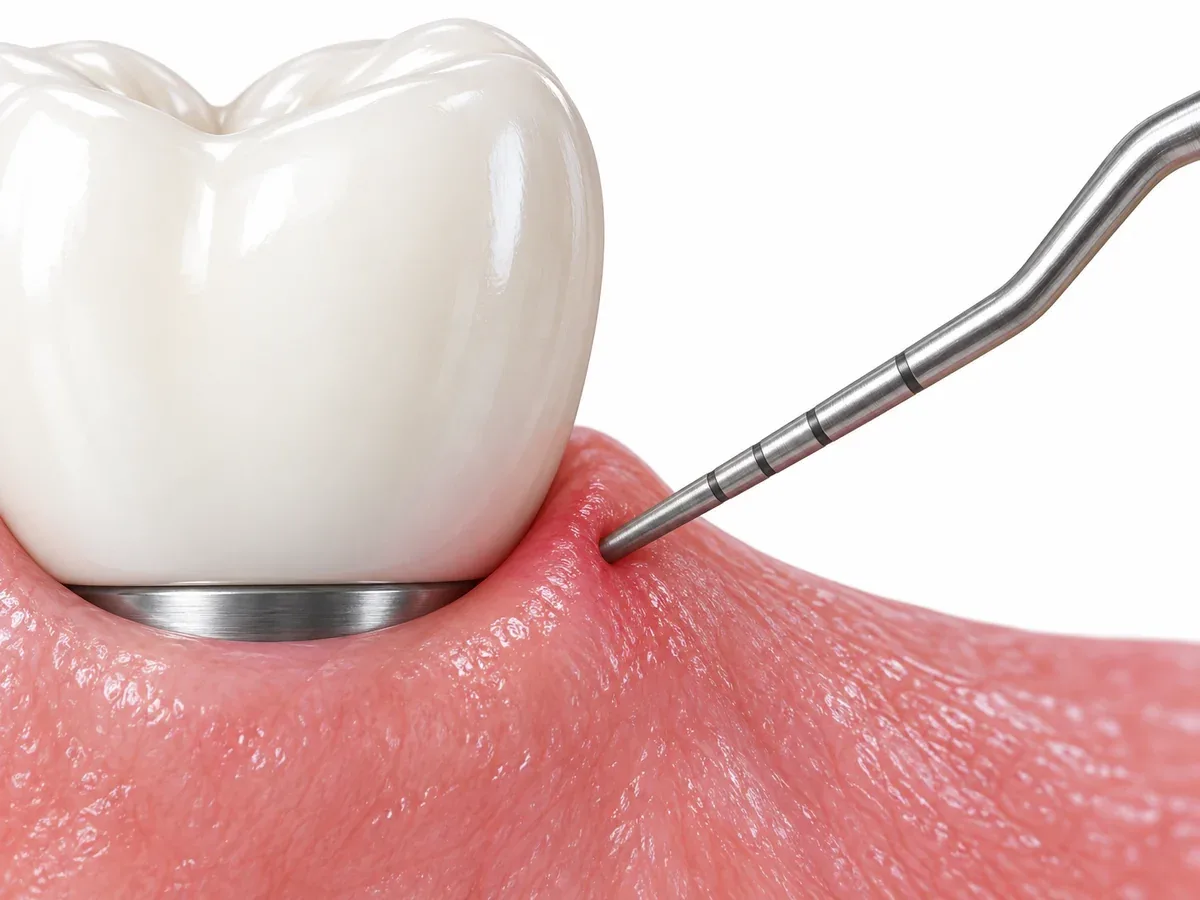
Can it be reversed? It depends on the stage, and we will be honest about each one.
| Stage | What we do | What to expect |
|---|---|---|
| 1. Gum alone | Remove biofilm and tartar, find missed spots, reshape a crown that cannot be cleaned | The gum mostly recovers |
| 2. Bone loss has begun | Open the gum, clean the implant surface, add a bone graft if needed | The first goal is to stop progress |
| 3. Advanced | Remove the implant, let the bone heal, then plan again | Conditions are worse than the first time |
At stage 2, we do not tell patients that all the lost bone will come back. Stopping it and reversing it are different things.
At stage 3, bone is short, so a graft is needed. The chance of a new implant holding well is also lower than the first time.
Put the three stages side by side and the answer is clear. With peri-implantitis, coming in at stage 1 rather than stage 3 makes all the difference.
We also see implants placed at other clinics. Parts can differ and repairs may take longer, so bring any implant record you have. If you have none, there are still ways to proceed.
Why does implant cleaning need different tools?
This is not widely known, so we want to explain it.
Metal scaling tools or standard curettes leave scratches on the titanium surface. Those scratches become places where bacteria stick more easily next time. An attempt to clean ends up creating a new source of contamination.
So cleaning to prevent peri-implantitis must remove biofilm without damaging the surface. It takes more work and more time, but it has to be done.
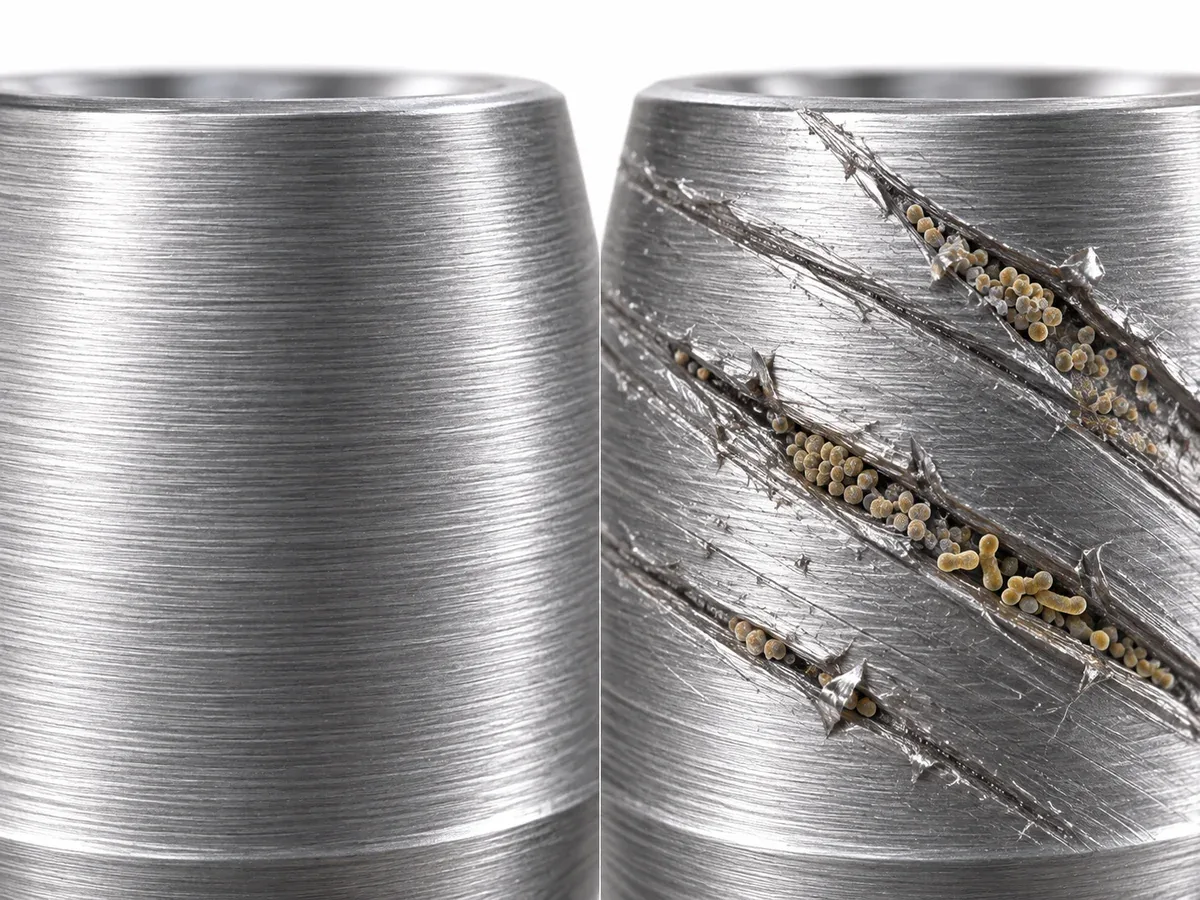
At home, hard brushing is not enough. Implant crowns have a more complex shape than natural teeth, so there are always spots a toothbrush cannot reach. Peri-implantitis starts in exactly those blind spots.
- Use an interdental brush and floss every day.
- Do not poke them in and out like a toothpick.
- Rub them against the implant surface, as if wiping a wall.
- For bridges joining several implants, use a floss that threads underneath.
Mouthwash helps, but it cannot remove biofilm stuck inside the gum gap. It does not replace interdental brushes and floss. Mouths differ, so it is quicker for us to show you at a check-up.
What can be done at placement, and when should you come in?
Peri-implantitis is not just a matter of care. Planning at placement also plays a big part.
If you grind heavily or love hard foods, your implants carry several times the usual load. For such patients, the average number of implants is not always right. Depending on the case, we sometimes place one or two more than first planned.
This is not about charging more; it takes more time and materials. But one extra implant can shape the next 20 or 30 years, because bone lasts longer when the load is shared.
Adding implants is not always the answer to peri-implantitis, either. Placed too closely, they cut blood flow to the bone between them, and that bone melts. The rule is not "more" but "evenly spread."
Come in early if you notice any of these:
- A smell around the implant
- Bleeding from that one spot when you brush
- Red or swollen gums
- Chewing feels different from before
- Receding gums that show the metal part
- A slight feeling of movement
Also come at your set time even with no signs at all. Having no signs is what peri-implantitis is known for.
If you are planning implants, ask these three questions at your consultation:
- "What tools do you use to clean implants?" Ask whether they use scaling tools or implant-specific ones.
- "Do you compare against an X-ray from when the crown was placed?" Bone loss shows up in comparison, so a baseline image matters.
- "Can you show me the spots I find hard to clean?" A specific answer means they are really looking.
Frequently asked questions
Does peri-implantitis always mean the implant must come out?
No. It depends on how much bone is lost, where, and whether the implant moves. At the gum stage most implants are saved, and even after bone loss begins, many patients stop the progress and keep using the implant for a long time.
Can bone that has melted grow back?
When the defect has a favorable shape, treatment and grafting can restore a good part of it. This does not always happen, and we can tell you what to expect after seeing the X-ray. We do not promise full recovery.
I brush very hard and still got it. Is it my fault?
We do not think so. Some people get it despite real effort. Usually a spot was out of the brush's reach, the crown was hard to clean, or there was no regular check-up.
Can I get peri-implantitis care in English in Busan?
Yes. We offer 1:1 English interpretation from the first consultation through the end of treatment. The clinic is near Seomyeon Station Exit 2 (5-min walk), opposite Lotte Hotel Busan, and you can call 010-8555-2854 (+82-10-8555-2854 from abroad).
An implant will not tell you it hurts.
So checking before pain appears is the way to protect it.
Caught at the gum stage, peri-implantitis ends with a cleaning.
Caught after the bone melts, it means surgery.
The same disease, decided by when you come in.
If you have implants and live in or near Busan, Reset Dental Clinic keeps an X-ray from the day your crown was placed and compares it at every visit. We offer 1:1 English interpretation throughout, and you can call 010-8555-2854 to book a check-up.
References
- KDA newspaper Dailydental (Chiui Sinbo), "65% of Implant Patients Have Experienced Peri-Implant Disease" (Korean Academy of Periodontology, 17th Gum Day) — how common peri-implant mucositis and peri-implantitis are, and how much each risk factor raises the risk
- KDCA National Health Information Portal, "Dental Implants" — complications including peri-implantitis, and maintenance
- KDA newspaper Dailydental (Chiui Sinbo), "Mastering Peri-Implantitis with the Korean Academy of Periodontology" — the academy's training course on diagnosing and treating peri-implantitis
- KDCA National Health Information Portal, "Gum Disease (Periodontal Disease)" — how gingivitis progresses to periodontitis
- KDCA National Health Information Portal, "Systemic Disease and Periodontal Treatment" — how smoking and diabetes relate to the gums
Written by Reset Dental Clinic Support Team
Medical review Dr. Na In-chae, Head Dentist · Periodontics Specialist
Last updated: September 19, 2026
This column is for general information and does not replace diagnosis or treatment for individual patients. If you have symptoms, please see a dentist.


