

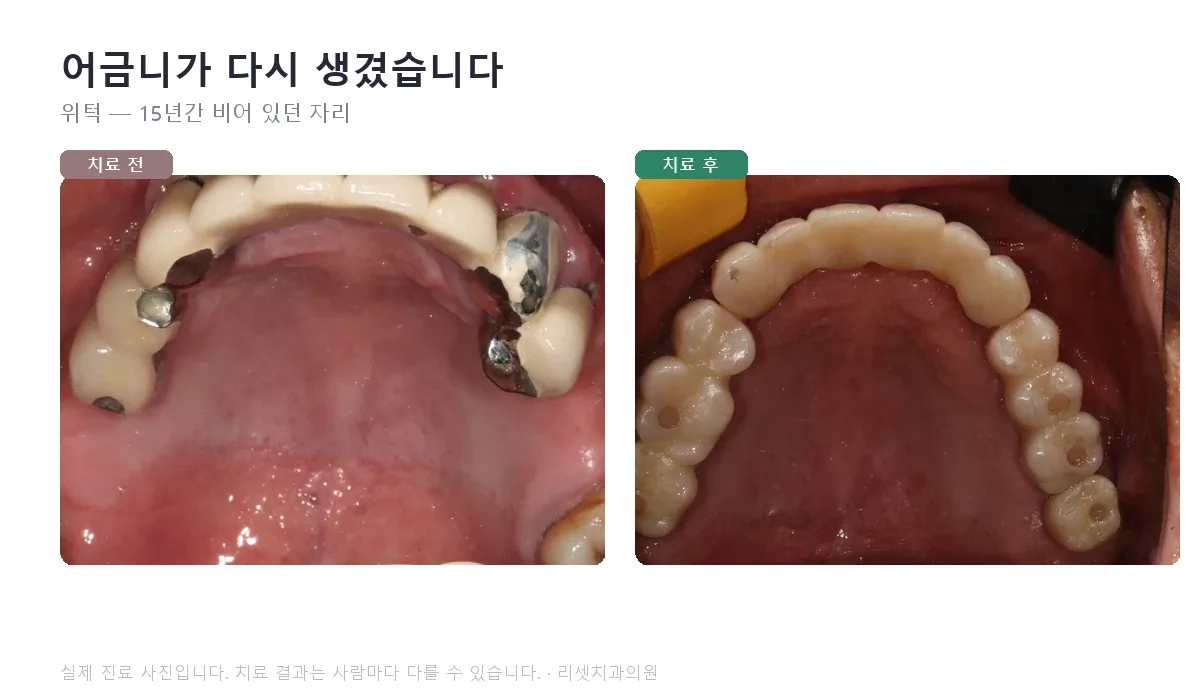
- The patient came to our clinic in Busan after living about 15 years without back teeth. In the upper jaw, the bone where a dental implant would go was thin.
- Instead of forcing bone into the gap, we first lifted the floor of the sinus to make room for bone to grow.
- We kept every tooth that could be saved and used dental implants just where saving a tooth was no longer realistic.
- The result has now held for 4 years and 3 months. We also describe the point where extra care was needed.
Case review by Dr. Na In-chae, Periodontics Specialist
"I have gone 15 years without my back teeth." That is what this patient told us at Reset Dental Clinic in Seomyeon, Busan. A gap left that long loses bone, so we started by building bone before placing any dental implant. For patients living in or visiting Korea, we provide 1:1 English interpretation from the first consultation through the end of treatment.
What was the patient's condition at the first visit?
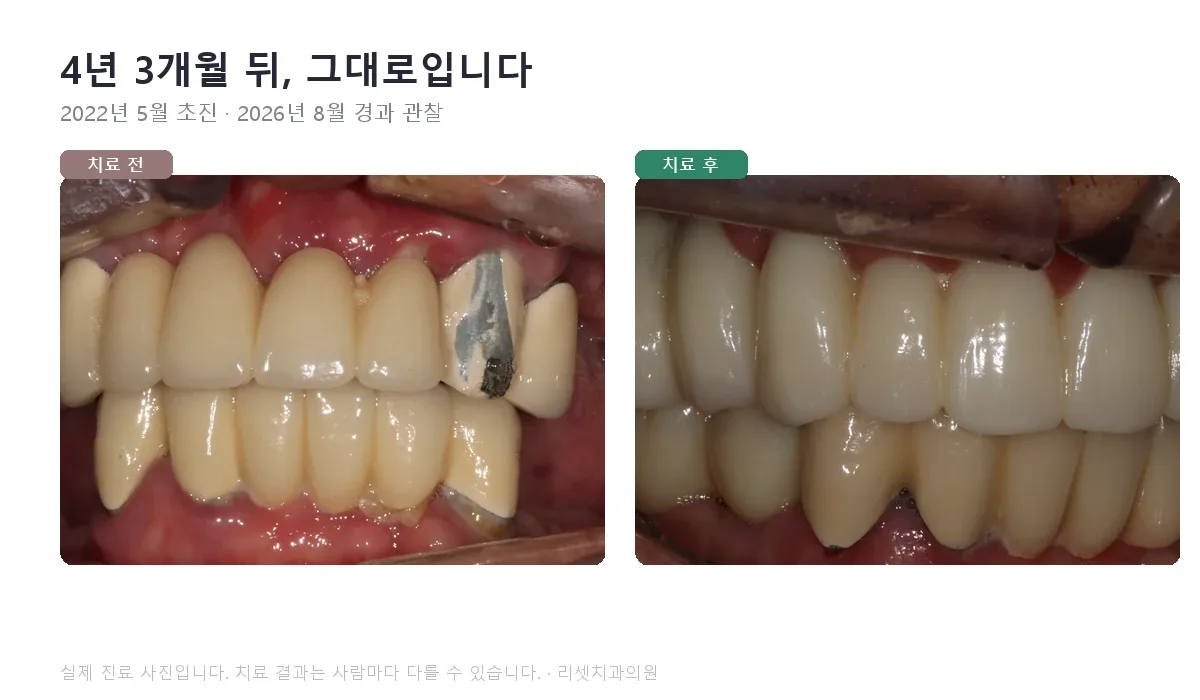
There was more than one problem. A crown on the upper left was broken, and the front bridge was loose. Several back teeth were missing in both the upper and lower jaw.
The examination showed chronic periodontitis spread widely through the mouth. Some teeth also had inflammation at the tip of the root.
The patient had high blood pressure but was not taking medicine for it. We checked this first, before any surgery was planned.
In a case like this, removing all the remaining teeth and starting over is the faster route. We take a different first step. We look for the teeth that can still be saved.
Some loose teeth firm up again with gum treatment. Inflammation at the root tip can also settle down with treatment in some cases.
Nothing fits as well as your own tooth. Each tooth that stays protects the bone in its spot and shares the chewing load with the dental implants. Pulling a tooth is the last decision we make.
| Area | Finding | What it meant for the plan |
|---|---|---|
| Back teeth | Several missing, upper and lower, for about 15 years | Bone had shrunk where dental implants would go |
| Upper left | A broken crown | Needed to be assessed with the other teeth |
| Front teeth | A loose bridge | Needed to be assessed with the other teeth |
| Gums | Chronic periodontitis spread widely | Gum treatment had to come first |
| Root tips | Inflammation on some teeth | Treatment was tried before deciding on extraction |
| General health | High blood pressure, no medicine being taken | Checked before surgery |
Before any dental implant surgery, we ask patients to tell us about:
- any medicine they take regularly
- their recent blood pressure readings
- any condition, such as high blood pressure, that is not being treated
If blood pressure is under control, surgery is possible in most cases. This patient was not taking medicine, which is why we checked it before anything else.
Why did the bone have to come before the dental implant?
Where a tooth is missing, chewing forces no longer reach the bone. The bone slowly shrinks as a result. Fifteen years is a long time for this to go on.
The upper back teeth have a special feature. Above them sits the maxillary sinus, an air space in the upper jaw.
When the bone below it shrinks, the sinus seems to sink and widen. The height of bone left for a dental implant becomes thin.
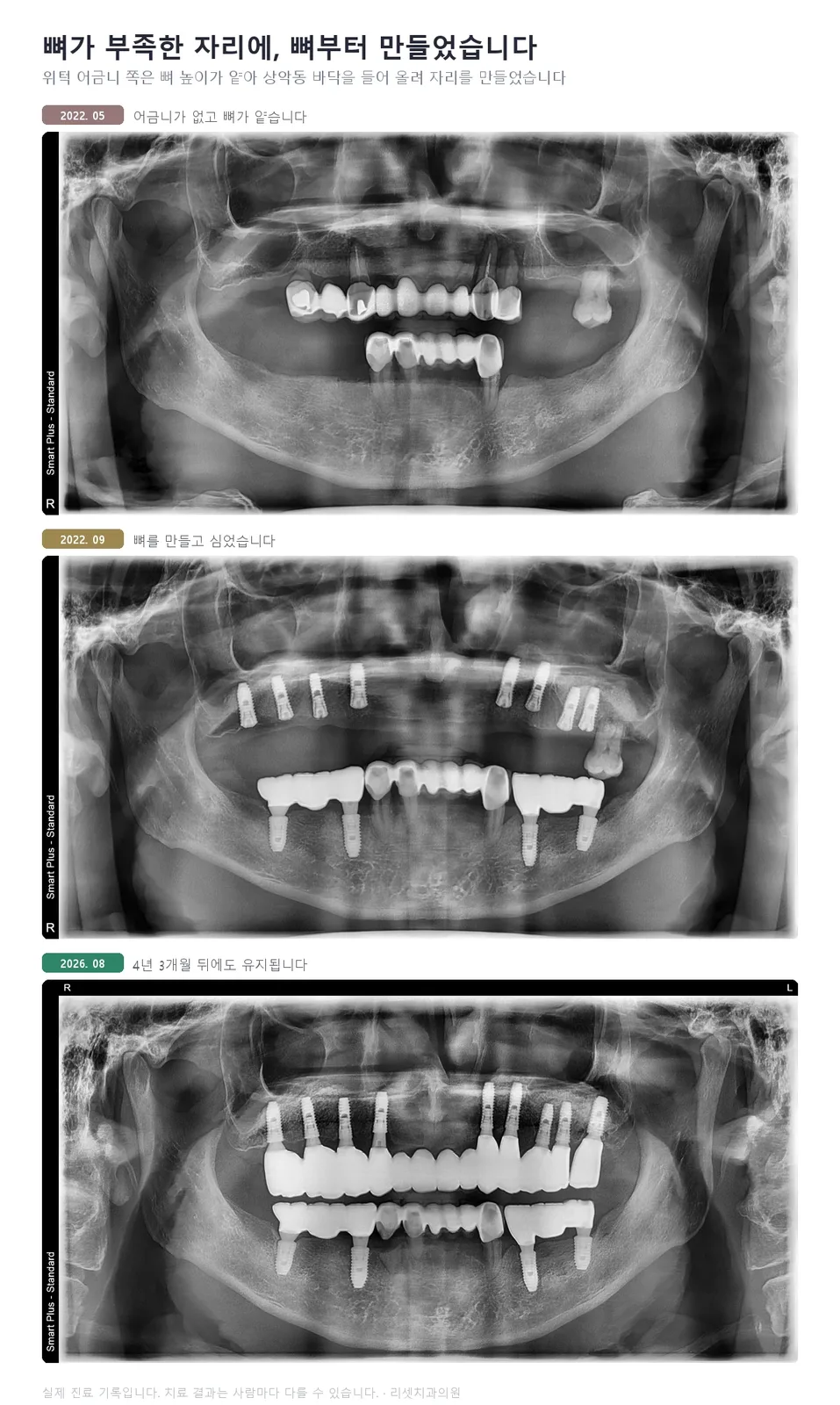
This patient's first panoramic X-ray showed exactly that. The bone in the upper back area was too shallow for an implant to be placed right away.
It is like leveling the ground before raising a pillar. Without bone to hold it, even a high-quality implant will not last long.
So the order was clear. First the bone, then the dental implant. Skipping the first step would have put the whole result at risk.
How was the bone rebuilt?
We carefully lifted the floor of the sinus and filled the space beneath it with bone graft material. This is called a sinus lift.
For this patient, we used a side approach, known as the lateral method. The sinus floor was reached from the side of the upper jaw.
A bone graft does not simply fill in missing bone. It is closer to creating a space and a framework where your own bone can grow. Once bone has filled in, the dental implant is placed.
In short, the sinus lift for this dental implant case went in four stages.
- The floor of the sinus was carefully lifted from the side.
- The space beneath it was filled with bone graft material.
- Time was allowed for the patient's own bone to grow into that framework.
- Once bone had filled in, the implants were placed.
The lower back tooth area was also short of bone in places. There, we did a bone graft at the same time as placing the implants.
Is a sinus lift risky? It is a common method for upper back dental implants. We check the shape and position of the sinus on a CT scan before starting.
After the surgery, there are a few precautions to follow, such as not blowing your nose hard.
How many dental implants were placed, and how?
We restored almost the whole upper jaw and the back teeth of the lower jaw.
In the lower jaw, we placed 4.5 mm wide, 12 mm long implants at #34 and #44. At #36 and #46, we placed 5.0 mm wide, 10 mm long implants.
During surgery, the bone felt D2, which means relatively dense. The initial holding force when the implant went in was 40 N. These were good conditions for the bone to bond with the implant.
We did a bone graft at the same time as placement. The area was then covered with a membrane that dissolves on its own.
| Tooth position | Width | Length |
|---|---|---|
| #34 and #44 | 4.5 mm | 12 mm |
| #36 and #46 | 5.0 mm | 10 mm |
| Bone density felt in surgery | D2 (relatively dense) | |
| Initial holding force | 40 N | |
While the implants bonded with the bone, the patient wore a temporary denture.
When several teeth are treated at once, how you will chew in the meantime is a real practical issue. The right choice, a temporary denture or a temporary restoration, depends on the remaining teeth and where the implants go.
What were the dental implant treatment steps at our clinic in Busan?
Treatment followed five steps. Building bone added time, so the whole process took several months.
1. Examination and planning
Panoramic X-rays and a 3D CT scan showed how much bone remained, where the sinus sat and where the nerves ran.
We checked how loose each tooth was and the state of its root. Then we sorted the teeth into those we could save and those we could not. How much bone to build was decided after that.
2. Gum treatment
Periodontitis had spread widely, so gum treatment came first. A dental implant placed in inflamed gums will not last long.
3. Building bone and placing implants
We did the sinus lift and bone grafts, then placed the implants. The timing of placement was split according to the bone in each area.
4. Waiting
This is the time for the implants to bond with the bone. The patient used a temporary denture during this period.
5. Fitting the final teeth
The back teeth were joined together so they share the chewing force. After that, the bite height still had to be fine-tuned.
- Examination and planning with X-rays and 3D CT
- Gum treatment for the widespread periodontitis
- Sinus lift, bone grafts and implant placement
- Healing time with a temporary denture
- Final teeth fitted, joined together, and the bite adjusted
How long treatment takes depends on the bone that remains. When bone building is part of the plan, it takes longer, and we explain the expected timeline after the scans.
How does it look more than four years later?
The panoramic X-ray from August 2026 shows the bone around the implants holding up well. The patient is chewing without problems.
It was not all smooth, though. In 2024, decay formed where a dental implant met a natural tooth. That tooth was removed, an implant was added, and one more bone graft was done.
This is not unusual. An implant itself cannot decay, but the natural teeth beside it can.
The space between an implant and a natural tooth is also hard for a toothbrush to reach. Plaque can build up there more easily.
| When | What happened |
|---|---|
| May 2022 | First visit after about 15 years without back teeth |
| During treatment | Gum treatment, sinus lift, bone grafts and implants; temporary denture while healing |
| 2024 | Decay in a natural tooth next to an implant; tooth removed, implant added, one more bone graft |
| August 2026 | Bone around the implants holding up well, 4 years and 3 months on |
What does a dental implant need to last?
For this patient, we recommend a scaling and check-up once a year. We also ask that an interdental brush is used every day.
A dental implant cannot get tooth decay. However, it is more vulnerable to gum disease than a natural tooth.
A natural tooth has a ligament around its root. It holds back the spread of inflammation to some degree. An implant does not have this structure.
Most of the work at a check-up is finding problems before they grow. This matters even more when several implants have been placed, as in this case.
| Natural tooth | Dental implant | |
|---|---|---|
| Tooth decay | Can develop | Does not develop |
| Around the root | A ligament that holds back inflammation to some degree | No ligament |
| Gum disease | Some natural protection | More vulnerable |
Once an implant is in, can you stop worrying about that spot? No. The natural teeth beside it can still decay, and the gum around it can still become inflamed.
This patient's daily and yearly routine looks like this:
- scaling and a check-up once a year
- an interdental brush for the spaces between teeth and implants
- attention to the natural teeth next to the implants
Frequently asked questions
I have lived without back teeth for years. Can I still get a dental implant?
In most cases, yes. The longer a gap stays empty, the more bone is lost, so a bone graft or sinus lift may be needed too. X-rays and a CT scan of the remaining bone show which method is needed.
How do I eat while several implants heal?
A temporary denture or temporary restoration is used while the implants bond with the bone. This patient used a temporary denture.
Wouldn't it be simpler to remove all my teeth and start over?
It is faster. But nothing fits as well as your own tooth, and each tooth that stays protects the bone. We first check whether gum treatment can stabilize a loose tooth.
Can I get dental implant treatment in English in Busan?
Yes, we provide 1:1 English interpretation from the first consultation through the end of treatment. The clinic is near Seomyeon Station Exit 2 (5-min walk), opposite Lotte Hotel Busan. Call 010-8555-2854, or +82-10-8555-2854 from abroad.
Even after many years with a gap, there is usually a way forward.
But that way is not decided from a single photo.
We check the remaining bone and nerve position with panoramic X-rays and 3D CT.
We also look at your chewing habits, gum health and general health.
Explaining why a method is needed, until it makes sense to you, comes first.
If you are considering a dental implant in Busan, we offer 1:1 English interpretation for patients living in or visiting Korea. Call 010-8555-2854 to book a consultation.
References
- KDCA National Health Information Portal, "Dental implants" — definition of implants and osseointegration, treatment time, care and complications
- KDA Dental News, "65% of implant patients have experienced peri-implant disease" (17th Gum Day, Korean Academy of Periodontology) — prevalence and risk factors of peri-implant disease, maintenance intervals
- KDCA National Health Information Portal, "Gum disease (periodontal disease)" — how gum inflammation progresses to the jawbone
- KDCA National Health Information Portal, "Systemic disease and periodontal treatment" — general health factors such as smoking and diabetes, and the gum tissues
- KDA Dental News, "Implant patients aged 65 and over exceed 800,000 last year" — growth in the number of implant patients in the country
Written by Reset Dental Clinic Support Team
Medical review Dr. Na In-chae, Head Dentist · Periodontics Specialist
Last updated: September 19, 2026
This column is for general information and does not replace diagnosis or treatment for individual patients. If you have symptoms, please see a dentist.


