

- Whether a molar gets a filling or a crown depends on how much of the remaining tooth can be trusted. The deciding factor is the amount of wall left, more than the size of the cavity.
- A filling removes less tooth. When the damage is wide, though, filling it directly in the mouth may not be enough.
- A crown covers the whole top of the tooth. It holds the tooth together, but more tooth is removed. We explain both options for patients in Busan.
- Either way, biting force and habits strongly affect how long it lasts. The material alone does not decide it.
"Can this be filled, or does it need a crown?" It is one of the questions we hear most before molar treatment at our clinic in Seomyeon, Busan. Hearing different advice about the same tooth can make it even more confusing. For patients living in or visiting Korea, we provide 1:1 English interpretation from the first consultation through the end of treatment.
This column draws on Korea's national health information on resin fillings and all-ceramic crowns. It explains how the two treatments differ, where the line falls and what to ask at a consultation.
What is the difference between a filling and a crown?
The two treatments differ in how much of the tooth they cover. A filling removes the damaged part and fills that space with material.
A crown works differently. The Korea Disease Control and Prevention Agency (KDCA) describes a crown as a treatment that covers the entire top part of a damaged tooth. The remaining tooth is shaped into a post, and a cap goes over it.
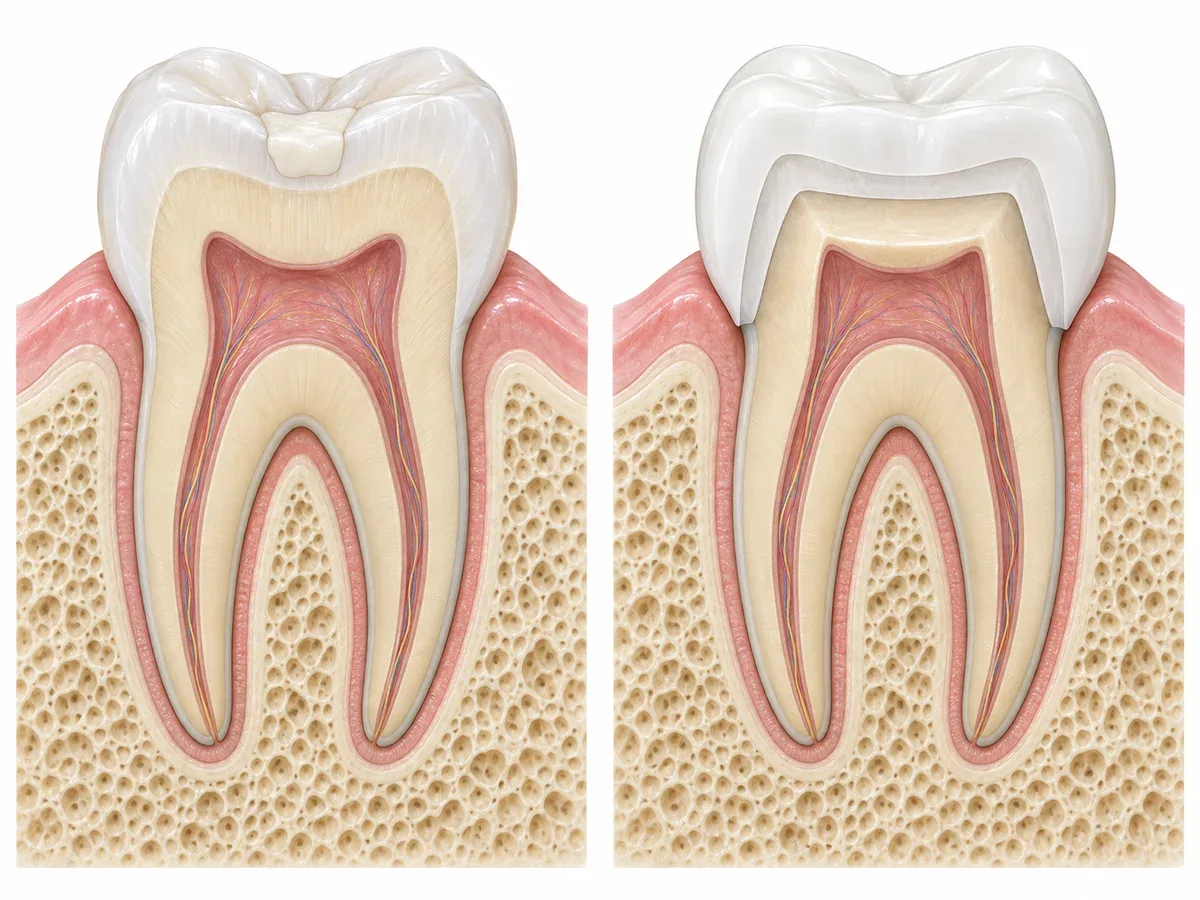
The materials differ too. Composite resin is the most widely used filling material. It is a blend of organic polymer and mineral filler.
The KDCA explains that resin is close to tooth color and looks natural. Because it bonds to the tooth, removal can be kept to a minimum.
Metal does not bond to the tooth, so more tooth has to be cut away to keep it from falling out. Resin stays in place by bonding, so no extra cutting is needed to hold it.
When is a filling enough for a molar?
The KDCA lists the cases where composite resin is used.
- treating decay in front teeth and molars
- repairing teeth chipped or cracked by injury
- closing small gaps between teeth
- correcting teeth with an unusual shape or color from birth
- repairing wear at the neck of the tooth, near the gum
On wear at the neck of the tooth, the KDCA is specific. It is not just a cosmetic issue. It can make teeth sensitive to cold, and deeper wear can expose the nerve or let the tooth break when chewing.
So early treatment is advised, and composite resin that bonds to the tooth is described as the most suitable material there.
Another strength of resin is that it is easy to repair. The KDCA notes that a filling can be partly redone and maintained, and resin suits almost every type of restoration.
In other words, small damage can be fixed with a small repair. That keeps more of your own tooth over the years.
Where does a filling reach its limit?
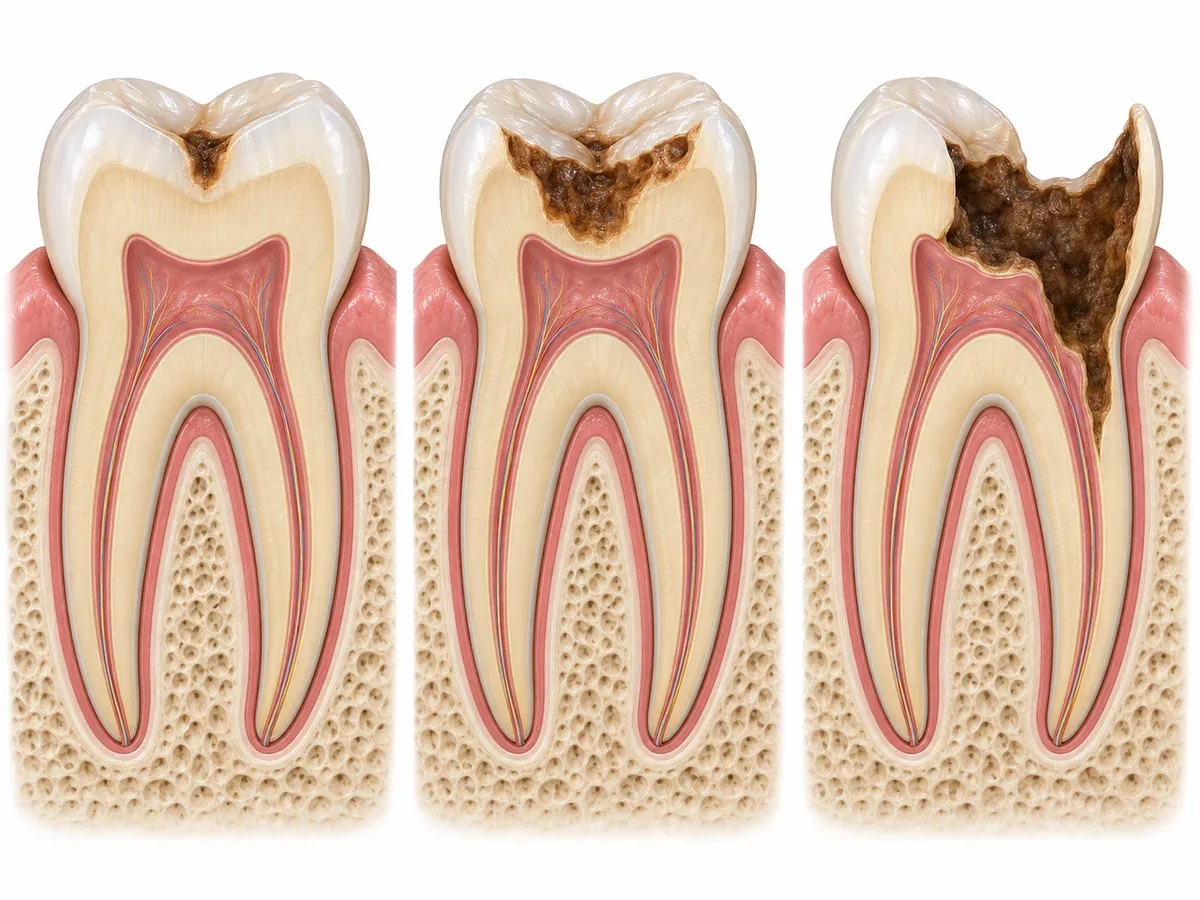
The KDCA is clear about the limits. When decay is extensive, a direct resin filling may be difficult.
Resin is built up directly inside the mouth. The wider the area to fill, the harder it becomes to get accuracy and strength right.
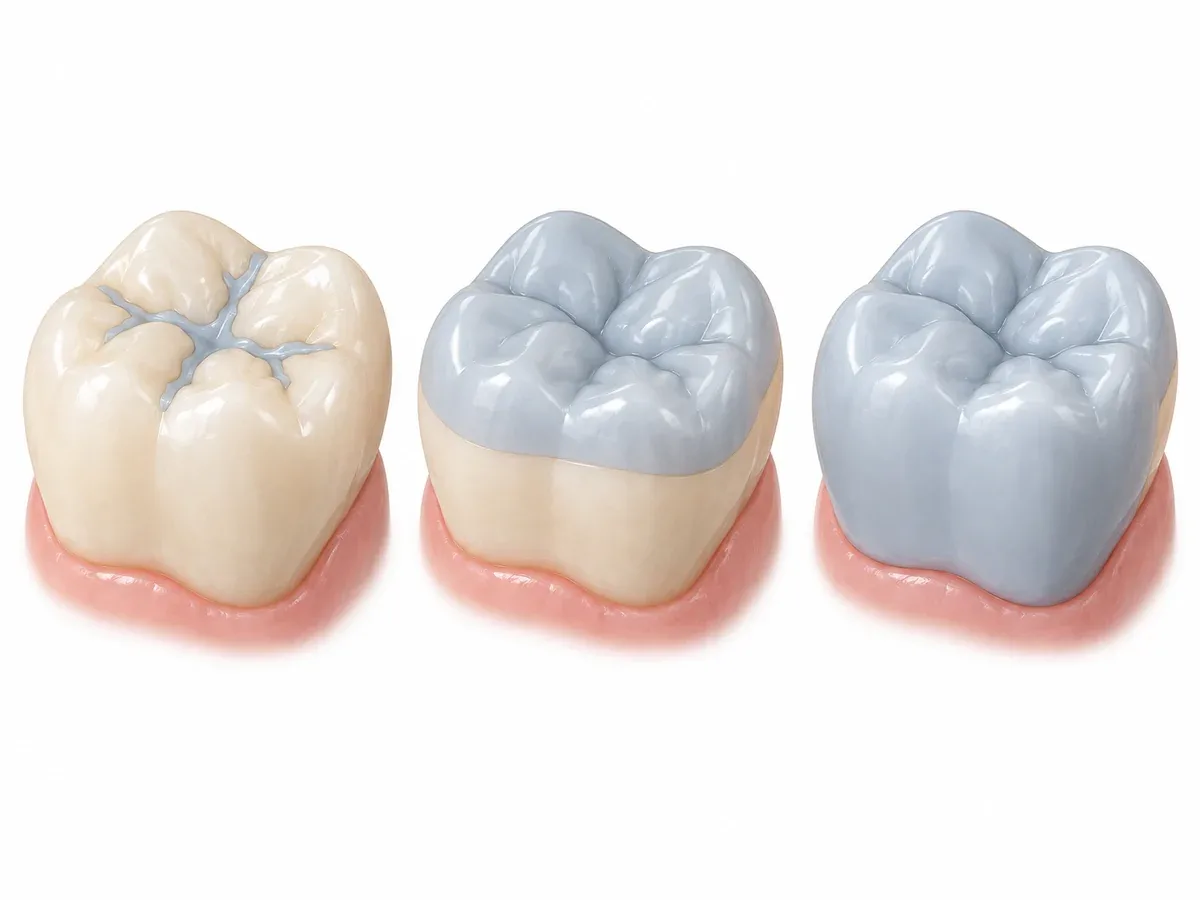
There is a middle option. When direct filling is difficult, the KDCA says the tooth can be prepared and an impression taken, so the restoration is made outside the mouth. This is called an inlay or onlay.
Compared with a direct filling, an inlay or onlay can be made more accurately and with greater strength. So there is one more choice between a filling and a crown.
Strength is worth noting too. Composite resin has improved a great deal and is widely used in front and back teeth. Still, the KDCA says its wear resistance is somewhat lower than other materials, so areas under heavy chewing tend to wear down.
| Option | How it is made | When it tends to fit |
|---|---|---|
| Resin filling | Built up directly in the mouth and bonded to the tooth | Smaller damage with thick walls left |
| Inlay or onlay | Made outside the mouth from an impression | Wider damage that is hard to fill directly |
| Crown | Covers the whole top of the tooth | Thin walls, fractures, or after a root canal |
When is a crown needed, and why after a root canal?
The KDCA's guide on all-ceramic restorations sums up when one is needed.
| Purpose | Details |
|---|---|
| Restoring a damaged tooth | Decay, heavy wear or grinding, a broken tooth, protection from fracture after a root canal |
| Bridge | Replacing a missing tooth by anchoring to the teeth on both sides |
| Reshaping teeth | Gaps between front teeth, slightly uneven teeth, discoloration, unusual shape or size |
The point to notice is protection after a root canal. The reason for the crown is not to make the tooth "stronger." It is to keep it from breaking.
Two KDCA guides point the same way. The resin guide explains that a root canal leaves an empty space where tooth was removed to find the canals. The tooth becomes much weaker than before, so that space needs reinforcing.
The all-ceramic guide goes a step further. It names protecting a root-canal-treated tooth from fracture as a reason to cover it.
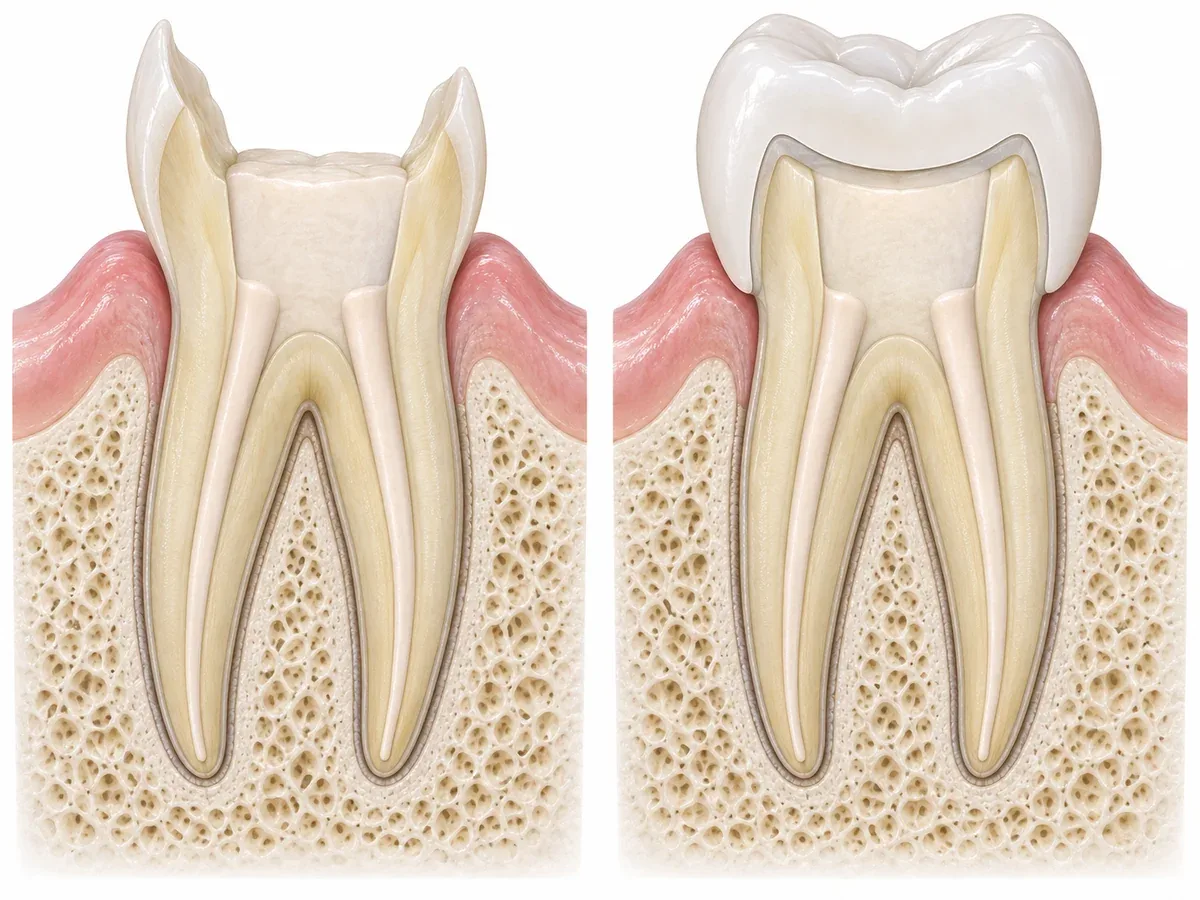
The KDCA's guide on sensitive teeth adds something useful. It describes root canal treatment as removing all the pulp and filling the canals, which makes the tooth lose its sense of temperature.
A tooth that has had a root canal no longer sends pain signals. That is why a crack or break can go unnoticed for a long time. No pain does not mean the tooth is strong.
How much tooth does a crown remove?
A crown removes more. The first drawback listed in the KDCA's all-ceramic guide is that it needs slightly more tooth removal than a metal restoration.
It also says that if the tooth is short, there may not be enough room, and the crown cannot be made. Ceramic needs a certain thickness to hold up.
The KDCA's laminate guide makes the difference clearer. It describes a crown as removing tooth from the whole surface. Because it covers the tooth completely, it is stronger and more durable, but more tooth is removed.
A laminate, by contrast, shaves the enamel surface minimally and bonds a thin shell about 0.5–1.0 mm thick.
How much will be removed is something you should hear before you decide. In a ruling reported by the Korean dental newspaper Dailydental, a clinic advertised "no reduction" or "0.1–0.2 mm reduction" but actually removed about 0.3–0.5 mm.
The Suwon District Court held that if as much reduction as usual is needed, the clinic must explain this and get consent in advance, and it ordered damages. The case involved laminates, but the principle is the same: you should be told how much will be removed and agree to it.
What should you know about metal-free ceramic crowns in Busan?
An all-ceramic crown is made from strengthened ceramic without metal. The KDCA lists these advantages.
- No metal means no gum discoloration and no dark line at the gum edge.
- The smooth surface makes it hard for bacteria to stick, so the risk of new decay at the edge (secondary caries) and harm to the gums is lower.
- It suits digital methods, so treatment can be simpler and faster.
The guide lists drawbacks as well. Stronger ceramics are less translucent, and more translucent ceramics are weaker. A sudden bite on something hard can break it.
Stronger ceramics also bond less well to dental cement. In poor conditions, such as a short tooth, the crown may come off.
Zirconia and lithium disilicate are the main materials. Early all-ceramic crowns were weak and used for single front teeth. With strengthened ceramics and digital manufacturing, they can now be used for molars and bridges.
Different "ceramics" behave differently. So it is fair to ask which material will be used on your molar.
Why do teeth and restorations break?
The checks listed in the KDCA's ceramic guide show what dentists look at before treatment.
- how well you keep your mouth clean, and your gum health
- whether you bite with unusually strong pressure
- whether there is enough room between the upper and lower teeth
- what material the opposing tooth is made of
- whether the tooth's nerve is still alive
In other words, we look not just at the tooth but at the force it will have to take.
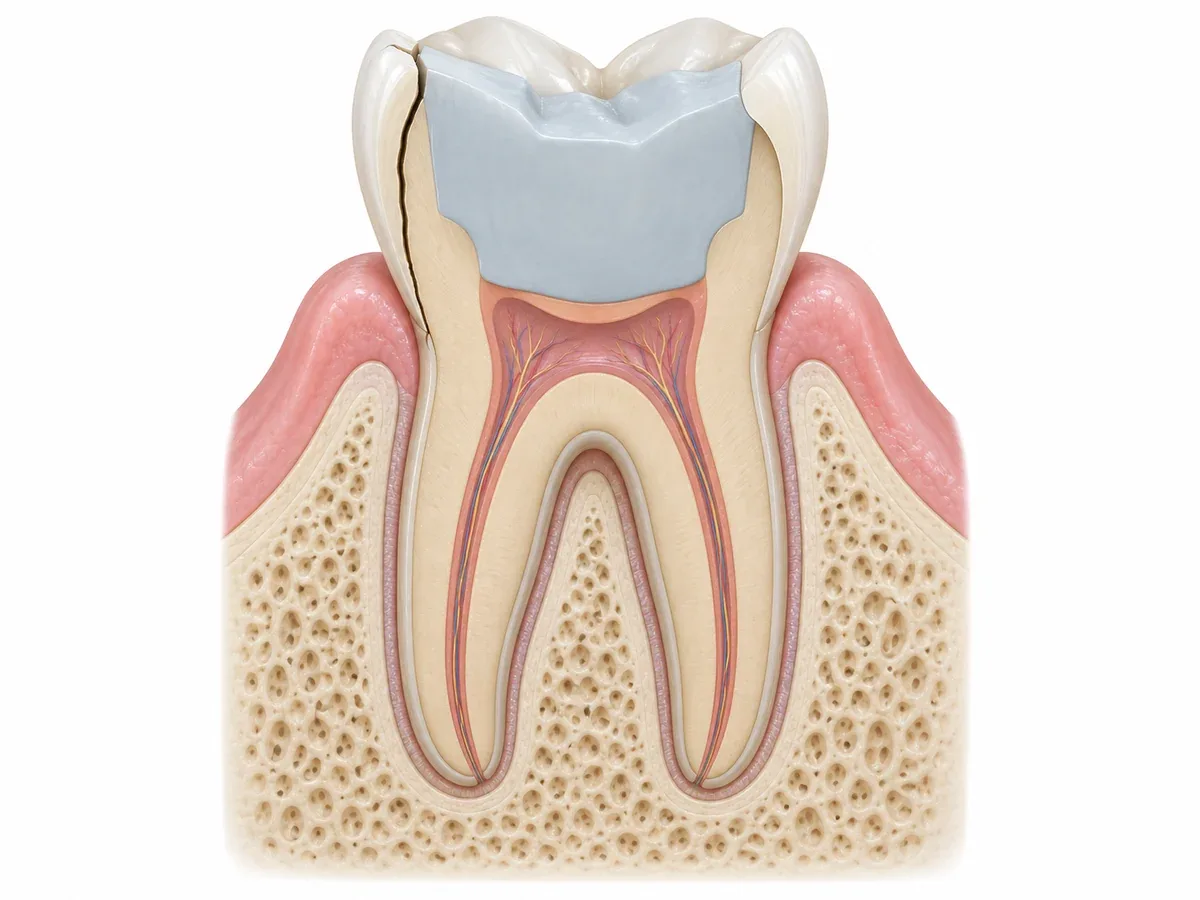
The KDCA's guide on sensitive teeth explains that a very strong bite puts heavy stress on teeth. This shows up as bending and twisting at the weakest point, with tiny fractures at the neck of the tooth. Grinding can also wear down the chewing surfaces overall.
So aftercare advice is largely about force. The ceramic guide warns that chewing very hard food with too much force can break both the crown and the tooth.
If you grind or clench in your sleep, a night guard may be needed to protect your teeth and crowns. Good brushing and regular scaling are also advised.
Crowned teeth can still decay. The KDCA lists the risk of new decay as lower, not absent, so the edge where the crown meets the gum needs ongoing care.
What can happen after treatment, and how long does it last?
Both KDCA guides list possible side effects openly. For all-ceramic crowns, they include.
- fracture of the tooth or the crown
- the crown coming off
- nerve irritation that ends up needing a root canal
- discomfort in the bite, jaw joint or chewing muscles from a new crown
Ceramic used for a long time also loses strength and develops cracks, making it more likely to break.
The resin guide explains that pigment can settle into tiny gaps on the surface and cause staining. Wine, green tea, black tea, curry, tobacco and coffee are given as examples. Stains around the edge can usually be polished off, so regular care helps.
Sensitivity is a common worry. After tooth is removed to treat decay or a fracture, the sensitive dentin inside is exposed, and cold food can sting. If the pulp is healthy, this usually fades with time.
If pain lasts long after the cold is gone, the nerve may be inflamed, and an exam is needed. A resin filling that keeps coming loose is redone, and we also look at the force on that spot.
| Restoration | Reported lifespan | Note |
|---|---|---|
| Composite resin | 3.3–16 years | Studies vary widely, so an exact figure is hard to give |
| All-ceramic crown | About 10 years | Generally shorter than metal-ceramic crowns |
| Laminate | About 5–10 years | With proper care |
All three guides add the same caution. Results vary a great deal with the tooth's condition before treatment, oral hygiene, eating habits and upkeep. The numbers are a guide, and real lifespan comes from those conditions.
Frequently asked questions
Does a large cavity always need a crown?
Size alone does not decide it. The KDCA says direct filling may be hard when decay is extensive, and it offers inlays and onlays as another choice. We decide by looking at wall thickness and biting force together.
How many visits does a crown take?
The KDCA's all-ceramic guide says this treatment alone usually takes 1–3 weeks and 1–3 visits. If gum treatment or a root canal is also needed, it takes longer.
Should I tell the hygienist I have a ceramic crown?
Yes, it helps. The KDCA's laminate guide notes that ultrasonic scalers can damage porcelain in some cases, so it is good to mention your restorations in advance.
Can I get this treatment in English in Busan?
Yes. We offer 1:1 English interpretation from the first consultation through the end of treatment. The clinic is near Seomyeon Station Exit 2 (5-min walk), opposite Lotte Hotel Busan, and you can call 010-8555-2854 (+82-10-8555-2854 from abroad).
Whether to fill or crown is decided
by the walls left, not the size of the cavity.
We consider the options that remove less first,
but we do not leave walls that cannot hold.
If you are in Busan and wondering about a filling or a crown, Reset Dental Clinic offers 1:1 English interpretation from your first consultation through the end of treatment. Call 010-8555-2854 to check your molar with X-rays.
References
- KDCA National Health Information Portal, "Resin Treatment (Dental Composite Resin)" — makeup of composite resin and minimal removal through bonding, uses including decay, fractures, neck wear and reinforcement after root canal treatment, easy partial repair, limited wear resistance, difficulty of direct filling for extensive decay and inlays and onlays, staining and sensitivity, and a reported lifespan of 3.3–16 years
- KDCA National Health Information Portal, "All-Ceramic Crowns" — definition of a crown and when it is used, advantages of no metal, more tooth removal and limits with short teeth, the trade-off between strength and translucency, risk of coming off, zirconia and lithium disilicate, pre-treatment checks, 1–3 weeks and 1–3 visits, complications, aftercare including night guards, and a lifespan of about 10 years
- KDCA National Health Information Portal, "Laminate Treatment" — comparison showing crowns remove more tooth in exchange for strength, laminate thickness of 0.5–1.0 mm and lifespan of about 5–10 years, and possible porcelain damage from ultrasonic scalers
- KDCA National Health Information Portal, "Dentin Hypersensitivity" — why teeth feel sensitive after tooth removal exposes dentin and how it usually eases, when lasting pain suggests nerve inflammation, micro-fractures from heavy biting and grinding, and root canal treatment removing the sense of temperature
- KDA newspaper Dailydental (Chiui Sinbo), "Court Orders Damages for Excessive Tooth Reduction in Laminate Treatment" — a ruling that when as much reduction as usual is needed, contrary to advertising, the patient must be informed and give consent in advance
Written by Reset Dental Clinic Support Team
Medical review Dr. Kim Hyun-joo, Head Dentist · Esthetic Restorations
Last updated: September 19, 2026
This column is for general information and does not replace diagnosis or treatment for individual patients. If you have symptoms, please see a dentist.


