

- Pain from a cavity usually settles with painkillers. Pain from pulpitis barely responds to them.
- Pulpitis pain gets worse at night, with cold water and with sweets. It can feel like a migraine or an earache.
- When decay reaches the pulp, heat hurts, cold may actually ease the pain, and the tooth aches with no trigger at all.
- Left untreated, pulpitis can spread to the tissue around the root, and treatment can take longer.
Some patients in Busan tell us the same story: the pain is worse at night, painkillers do not help, and they cannot tell which tooth hurts. Public health sources link all three signs to one condition, pulpitis. For patients living in or visiting Korea, our clinic in Seomyeon provides 1:1 English interpretation from the first consultation through the end of treatment.
This column draws on Asan Medical Center's pages on acute pulpitis and tooth decay. It also uses KDCA pages on root canal treatment and on toothache and chronic pain.
What is pulpitis?
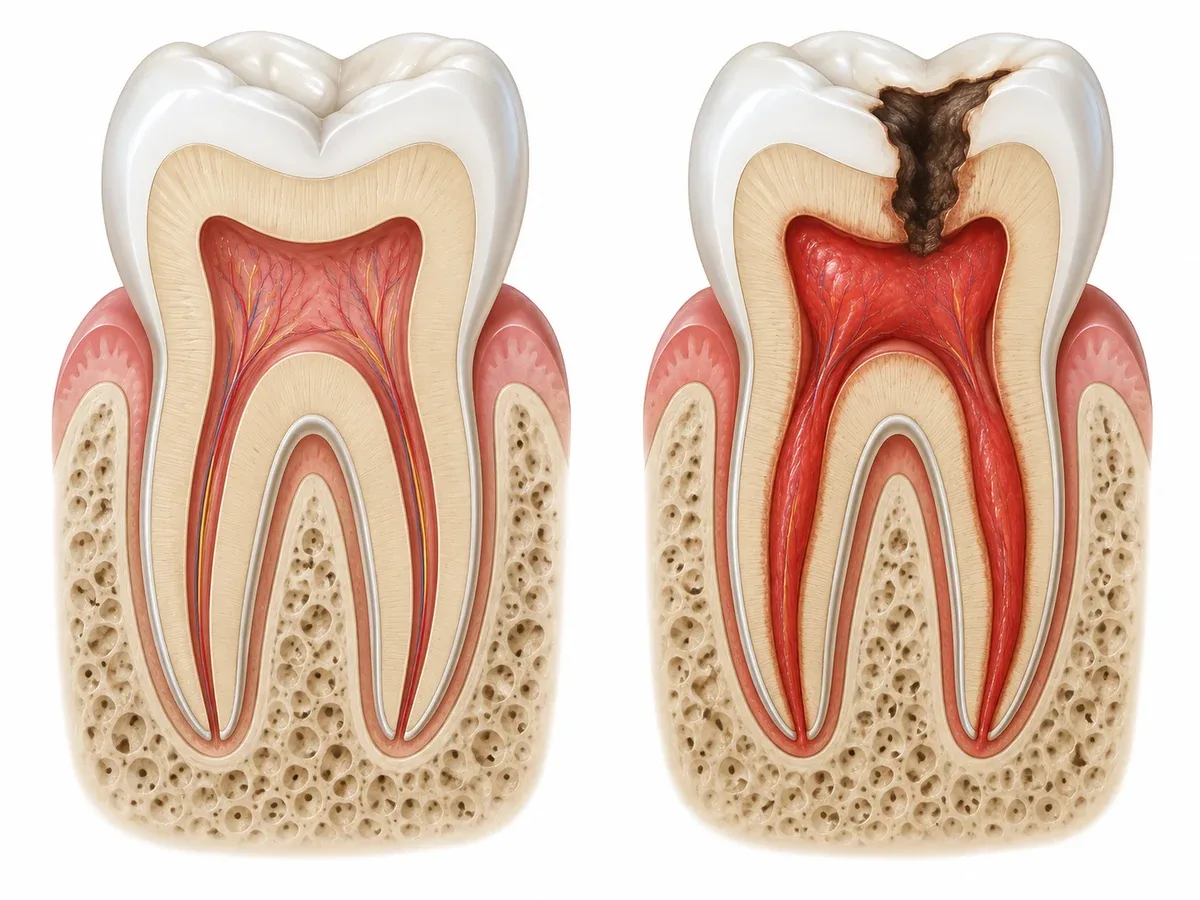
Asan Medical Center defines acute pulpitis as inflammation of the pulp. The pulp is the soft tissue inside the tooth, in a space called the pulp chamber.
The source adds one important line. Pulpitis can develop when the right time to treat a dental problem is missed.
There are two main causes:
- bacterial infection of the pulp from tooth decay
- trauma, when the tooth is injured
Here the source draws a key distinction. Both decay and pulpitis can cause severe tooth pain. But pain from decay usually settles with painkillers.
Pain from pulpitis barely responds to painkillers, and in severe cases the tooth may need to be removed. So pain that medicine does not touch is a signal in itself.
| Point | Tooth decay | Pulpitis |
|---|---|---|
| Where it starts | Enamel, then dentin | The pulp inside the tooth |
| Painkillers | Pain usually settles | Barely any effect |
| In severe cases | Decay can reach the pulp | The tooth may need to be removed |
How does pulpitis pain feel?
The symptoms in the source are specific. The main one is a severe toothache. The pain gets worse in these situations:
- at night
- when drinking cold water
- when eating sweet food
The toothache may also feel like a migraine or like an earache. Some patients really do say, "It is not my tooth, it is my head," or "My ear hurts."
The KDCA page on toothache and chronic pain helps explain this. Nerves in the mouth and face are closely tangled together. So the way pain shows up can change with both physical and emotional state.
The same page says the jaw joint's structure, its movement and the bite should be looked at together. It also notes that a bad bite does not always cause pain.
Looking at the stages of decay makes the picture clearer. Asan Medical Center's tooth decay page describes decay that has reached the pulp. Heat hurts, while cold actually eases the pain.
The tooth hurts even with no trigger, and painkillers do not help. These are the same features that mark pulpitis.
How does pulpitis compare with the stages of tooth decay?
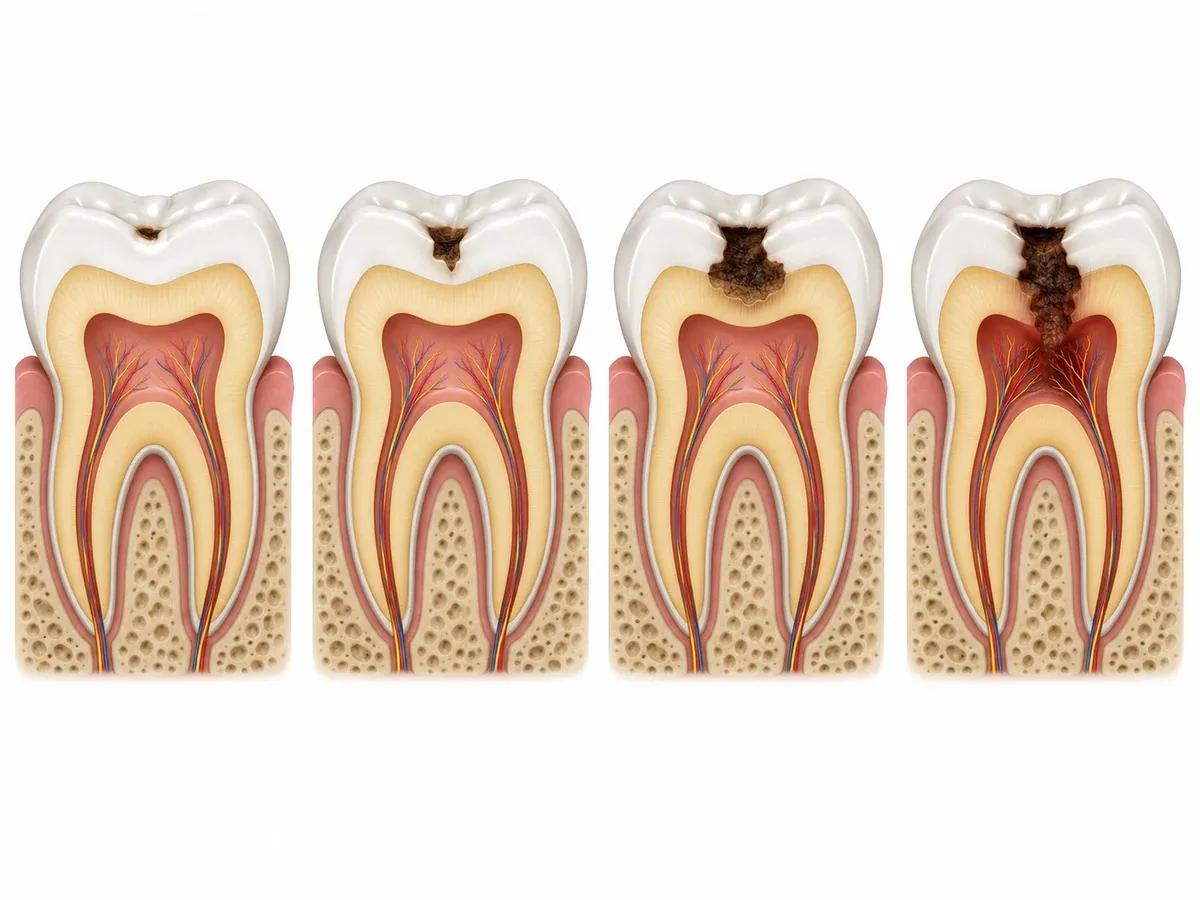
Asan Medical Center describes tooth decay as damage to the enamel that lets decay form in the dentin and pulp below. Bacteria in plaque, the film on the tooth surface, break down sugar and starch. The acid they make attacks the enamel.
The same page explains the stages of decay one by one:
- Decay limited to the enamel: almost no pain.
- Decay reaching the border of enamel and dentin: sensitivity to cold and to sweet tastes.
- Decay reaching the dentin: discomfort with cold and hot, and pain when chewing.
- Decay reaching the pulp: heat hurts and cold eases it, the tooth hurts with no trigger, and painkillers do not help.
- Pulp necrosis, when the pulp dies: no response to sensitivity tests and severe pain. An X-ray may show a lesion at the root tip.
The character of the pain changes between stage three and stage four. If a tooth that used to hurt when chewing now aches at rest, it has likely moved to the next stage.
At that point, the problem is no longer decay alone. The inflammation has reached the pulp, and that is pulpitis.
Notice that the early stages can be quiet. Decay limited to the enamel causes almost no pain, so regular check-ups matter before any pain appears.
| How far decay has gone | What the source says |
|---|---|
| Limited to the enamel | Almost no pain |
| Border of enamel and dentin | Sensitive to cold and to sweet tastes |
| Into the dentin | Discomfort with cold and hot; pain when chewing |
| Into the pulp | Heat hurts, cold eases it; pain with no trigger; painkillers do not help |
| Pulp necrosis | No response to sensitivity tests; severe pain |
How is pulpitis diagnosed in Busan?
According to the source, most people visit a dentist because of severe tooth pain. Pulpitis is then diagnosed by checking the state of the root canal on an X-ray.
For tooth decay, the Asan Medical Center page describes looking at the tooth and probing it with instruments. It calls X-rays essential.
The KDCA page on root canal treatment lists when that treatment is needed:
- when the tooth hurts badly with cold or hot
- when pus keeps coming back in the gum
Still, pain alone cannot pin down which tooth is the cause. As the toothache page notes, pain in the mouth and face can be felt away from where it starts. That is why X-rays and tests are used to confirm it.
| Step | What it shows |
|---|---|
| Your description of the pain | Night pain, triggers, and whether painkillers help |
| Looking and probing | Where decay is and how deep it seems |
| X-ray | The state of the root canal and any lesion at the root tip |
| Sensitivity test | No response can point to pulp necrosis |
At our clinic in Busan, it helps a great deal when patients describe their pain clearly. The questions in the last section of this column can help you prepare.
How is pulpitis treated?
The acute pulpitis page says the inflamed tissue can be removed and root canal treatment carried out. Root canal treatment is also called nerve treatment.
If the pain is severe, the tooth causing it may be removed. Which path fits depends on your tooth and is decided after examination.
The KDCA page describes root canal treatment as removing the infected pulp, cleaning the inside and sealing it. If it does not succeed, surgery may follow. Two examples are removing the root tip (apicoectomy) and intentional replantation.
After treatment, the page recommends a crown to keep the tooth from cracking. This is why a tooth is usually covered after root canal treatment. A tooth with its inside emptied cracks more easily from the side.
Can root canal treatment save the tooth? The source says root canal treatment can be done, but also that the tooth may be removed when pain is severe. It depends on how much of the tooth is left, which is why timing matters so much.
For decay that has not reached the pulp, treatment is different. The Asan Medical Center page says the decay is fully removed. The space is then filled with gold or tooth-colored resin.

What happens if pulpitis is left untreated?
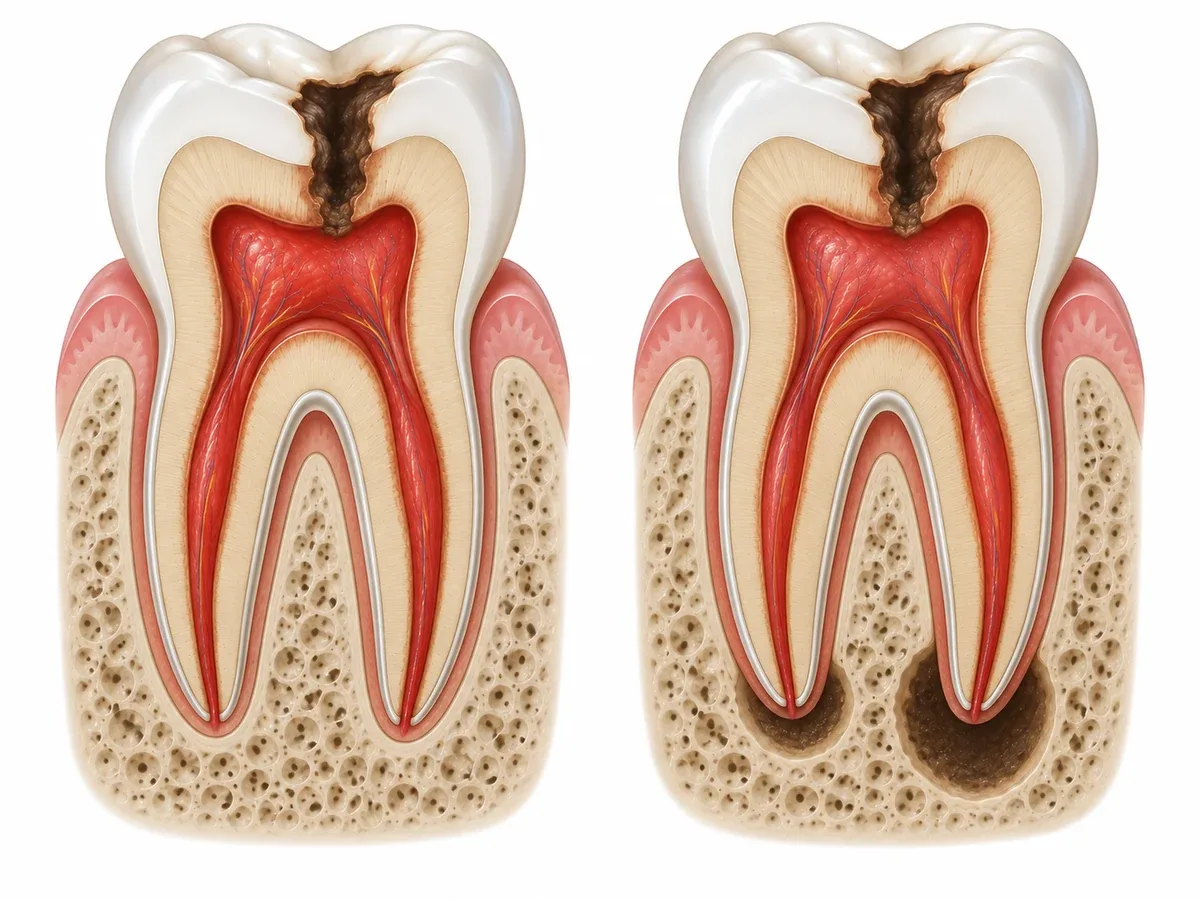
The source's section on progression is short but clear. Untreated pulpitis can spread to the periodontal ligament, the membrane between the root and the jawbone.
The result can be inflammation of that membrane. It can also lead to acute apical periodontitis, an infection at the root tip, and to gum disease. Treatment may then take longer.
Know, too, that pain going away does not always mean healing. The last stage in the tooth decay page is pulp necrosis, which shows no response to sensitivity tests.
When the nerve dies, the tooth itself may hurt less for a while. But a new problem can then begin at the root tip.
| Situation | What the sources say |
|---|---|
| Treatment | The inflamed tissue is removed and root canal treatment can be done |
| Severe pain | The tooth causing the pain may be removed |
| If root canal treatment fails | Surgery such as root-tip removal or intentional replantation |
| After treatment | A crown is recommended to prevent cracking |
| If left untreated | Inflammation can spread around the root, and treatment may take longer |
What can you do right now?
A caution in the source is also useful. Even without pulpitis, the blood vessels in the pulp can become congested.
Then cold water, cold food, or sweet or sour food can cause a strong, sharp pain. That pain fades within a short time.
But if the congestion worsens and pressure inside the pulp rises, severe pain can come at night or while eating. So the first step is to work out which stage you are in.
| State | Triggers | How the pain behaves |
|---|---|---|
| Congested pulp blood vessels | Cold water, cold food, sweet or sour food | Strong and sharp, but fades within a short time |
| Worse congestion, higher pressure | Night time, eating | Severe pain |
Keep track of these points and tell your dentist:
- whether the pain is a short twinge that stops, or a throb that continues at rest
- whether painkillers help or not
- whether heat or cold makes it worse, or cold makes it better
- whether the pain is worse at night
- whether it feels like a headache or an earache
These details help with the diagnosis. Bring them to your appointment rather than waiting for the pain to settle.
A short note on your phone works well. Write down when the pain started, what sets it off and how long each episode lasts.
Also note any painkillers you took and whether they made a difference. As the source explains, that single detail can help tell decay pain from pulpitis pain.

Frequently asked questions
Painkillers are not working. What does that mean?
The source uses this as a way to tell the two apart. Pain from decay usually settles with painkillers, while pulpitis pain barely responds. If medicine does not help, do not put off seeing a dentist.
Why does it hurt mostly at night?
The source says pulpitis pain gets worse at night. It does not explain why, so we will not go further than that. Still, night pain is one of the listed features, which makes it a reason to get checked.
Holding cold water in my mouth helps. Is that a good sign?
It may be a sign the problem has progressed. The tooth decay page says that once decay reaches the pulp, heat hurts and cold eases the pain. If you need cold water to cope, pulpitis may be the cause.
Can I get pulpitis treatment in English in Busan?
Yes. We offer 1:1 English interpretation from the first consultation through the end of treatment. The clinic is near Seomyeon Station Exit 2 (5-min walk), opposite Lotte Hotel Busan, and you can call 010-8555-2854 (+82-10-8555-2854 from abroad).
Pain that painkillers do not touch is a signal.
Night pain, pain with no trigger,
and pain that cold water soothes
all deserve a closer look.
If you think you may have pulpitis in Busan, Reset Dental Clinic offers 1:1 English interpretation from your first consultation through the end of treatment. Call 010-8555-2854 to arrange a visit.
References
- Asan Medical Center Disease Encyclopedia, "Acute Pulpitis" — definition as inflammation of the pulp that can develop when treatment is delayed, causes (bacterial infection from decay and trauma), why painkillers help decay pain but barely help pulpitis pain, symptoms worse at night, with cold water and with sweets and felt like a migraine or earache, X-ray diagnosis, root canal treatment or extraction, progression to the tissue around the root, and pain from congested pulp blood vessels
- Asan Medical Center Disease Encyclopedia, "Dental Caries" — definition, how acid from plaque bacteria attacks enamel, symptoms at each stage from enamel to pulp and pulp necrosis, diagnosis by inspection, probing and essential X-rays, and treatment by removing decay and filling with gold or tooth-colored resin
- KDCA National Health Information Portal, "Root Canal Treatment" — removing the infected pulp, cleaning and sealing the canal, when it is needed, surgical options such as apicoectomy and intentional replantation, and a crown afterwards to prevent cracking
- KDCA National Health Information Portal, "Toothache and Chronic Pain" — how tangled nerves in the mouth and face make pain vary with physical and emotional state, looking at the jaw joint and bite together, and why a bad bite does not always cause pain
Written by Reset Dental Clinic Support Team
Medical review Dr. Kim Hyun-joo, Head Dentist · Integrated Dentistry Specialist
Last updated: September 19, 2026
This column is for general information and does not replace diagnosis or treatment for individual patients. If you have symptoms, please see a dentist.


